Commercial Kitchen Company supplies commercial dishwashers for cafés, restaurants, bars, clubs, aged care kitchens and schools. This category covers the undercounter and front-loading machines — the ones that sit under or beside a bench and wash to a single rack. For hood-type machines see pass-through dishwashers; for continuous high-volume warewashing see rack conveyors.
Brands here include Hobart, Meiko, Winterhalter, Eswood, Classeq, Comenda, Washtech and Aristarco. Most are built around a standard square rack, and many are offered with heat recovery, an integrated drain pump or a reverse-osmosis rinse for a spot-free finish. Several are configurable as either a dishwasher or a glasswasher at installation.
Both showrooms are open to the public — Brisbane (Springwood) and Gold Coast (Bundall). Ring 1300 CKC 000 and we will tell you what is on the display floor. SilverChef equipment finance is available on eligible equipment.
Showing 1–16 of 43 resultsSorted by popularity
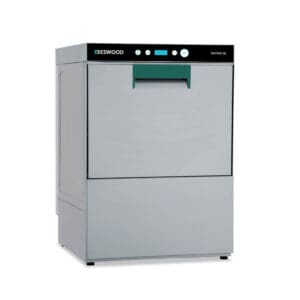
Dishwashers
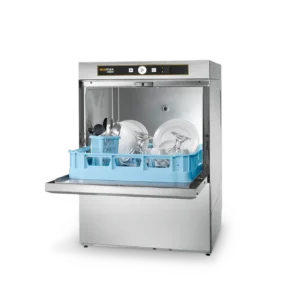
Dishwashers
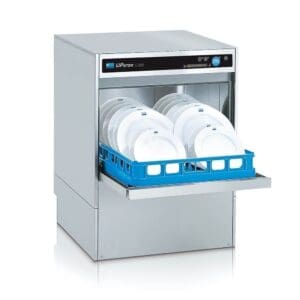
Dishwashers
Dishwashers
Dishwashers
Dishwashers
Dishwashers
Dishwashers
Dishwashers
Dishwashers
Dishwashers
Dishwashers
Dishwashers
Dishwashers
Dishwashers
Dishwashers
A commercial dishwasher is plumbed, drained and runs cycle after cycle through a service, so the decisions worth spending time on are the rack you need to wash to, the throughput you need at peak, and how the machine copes with your incoming water.
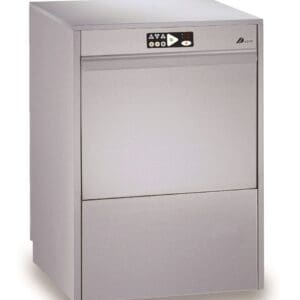
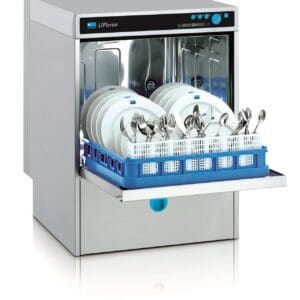
Undercounter and front-loading machines — the ones on this page — fit under or beside a standard bench and wash one rack at a time, with the higher-output units rated to around sixty racks an hour. They suit cafés, bars, small restaurants and back-of-house crockery and glass duties. Hood-type machines lift a hood so a rack slides in from the soiled side and out to the clean side, which is what carries a busy restaurant, hotel or function kitchen — see pass-through dishwashers. Rack conveyors move racks through the machine continuously for large hotels, banquet kitchens and central production — see rack conveyors. For pots, trays and bulk utensils, see utensil washers.
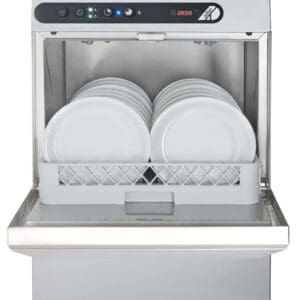
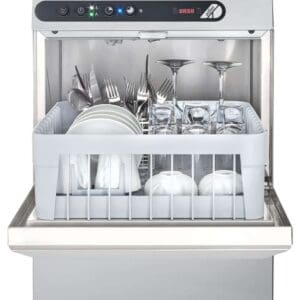
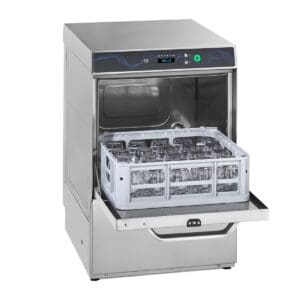
Most machines here are built around a standard square rack — commonly 500 x 500mm on dish machines and 400 x 400mm on glass machines — and a plate rack of that size takes around 18 dinner plates. What varies more than rack size is clear entry height, so measure your tallest stemware, your largest plates and anything else you intend to put through, and check it against the machine before you commit. Several undercounter machines can be set up as either a dishwasher or a glasswasher at installation, so if one machine has to do both jobs, ask.
Scale is the most common cause of premature failure in a warewasher, and manufacturers set a water hardness limit above which they expect a softener or water treatment system on the inlet. Find out your hardness before you buy, not after the first service call. Detergent and rinse aid are dosed by built-in chemical pumps on almost everything here, which takes the result off the operator, and better units add a refill signal so an empty drum is noticed before the wash quality drops. Reverse-osmosis and deionising options are offered across several ranges where you want glassware and cutlery to come out without polishing.
A commercial machine finishes on a hot rinse, and what matters at an audit is being able to show it happened. Most units here display wash and rinse temperature digitally so the readings can be logged for HACCP; some keep an internal hygiene log or export operating data over USB. A thermostop function holds the cycle until the rinse water reaches its set temperature rather than running on regardless. At connection your plumber will want WaterMark certification and built-in backflow prevention, so check both are specified.
Heat recovery is the option worth asking about: the machine draws hot vapour back into the incoming cold water, which cuts both the energy draw and the steam released into the room — enough, in some installations, to remove the need for an extraction canopy. Confirm that with your certifier rather than assuming it. An integrated drain pump lets you place the machine where the bench layout suits instead of where the floor waste happens to be. Some machines can also be connected to a hot water supply, which reduces the electrical load of the booster heater.
Hobart spans this range from undercounter machines through hood-type and rack conveyors to utensil washers, so a single-brand fit-out is possible. Winterhalter builds undercounter dish and glass machines with touch-screen control, a hygiene logbook and heat-recovery and reverse-osmosis variants. Meiko is German-made and covers undercounter and hood-type machines with reverse-osmosis and heat-recovery options. Eswood is Australian-engineered and covers the undercounter and pass-through end. Classeq is made in the UK and its undercounter machines can be configured as dishwasher or glasswasher. Comenda covers undercounter and pass-through with condensing-hood heat recovery. Washtech supplies a wide-body front-loading warewasher with heat recovery, and Aristarco an undercounter machine.
Our team has 35 years specifying warewashing into cafés, restaurants, hotels, function venues, clubs, aged care and schools across Queensland and Australia. Both showrooms are open to the public — Brisbane (Springwood) and Gold Coast (Bundall). Ring first on 1300 CKC 000 and we will tell you what is on the display floor, so you can look at rack size, entry height and controls in person. SilverChef equipment finance is available on eligible equipment, and delivery, installation arrangement, plumbing, drainage and electrical connection can be quoted alongside the machine.
Commercial dishwashers complete a cycle in 90 seconds to 3 minutes (vs 1.5-3 hours domestic), sanitise with 82°C rinse water (vs 60°C domestic), use commercial-grade detergents, and handle continuous-duty operation across multiple daily cycles. Domestic dishwashers fail quickly in commercial use and won't meet food safety sanitising requirements.
Undercounter (30-60 racks/hr) suits cafés, small restaurants, and bars washing under 500 items per shift. Pass-through hood-type (60-120 racks/hr) is essential for high-volume restaurants, hotels, function venues, and aged care washing 500+ items per shift. Wrong sizing causes service bottlenecks and excessive labour cost.
Thermal-sanitising commercial dishwashers must reach 82°C during the final rinse — Australian standard for pathogen kill. Most units pre-heat wash water to 60-65°C then use booster heaters for 82°C rinse. Chemical-sanitising systems use lower-temperature rinse with sanitiser injection — alternative for energy-conscious operations.
Modern energy-efficient commercial dishwashers use 2-4L per rack. Older or budget units use 6-10L per rack. For a high-volume operation running 50+ racks/hr over 6 hours, that's 600-2,400L per day difference — significant cost impact over a year. Specify modern energy-efficient units for new fitouts.
Commercial dishwashers require hot water supply (60-65°C minimum), cold water supply for booster, drain connection (200mm minimum), and dedicated electrical (10A-15A undercounter, 32A+ pass-through). Many units include detergent/rinse-aid auto-dosing requiring chemical supply lines. Always engage qualified trades for installation.
Yes — Commercial Kitchen Company partners with SilverChef for Rent-Try-Buy, lease, and hire purchase on every commercial dishwasher in our range. SilverChef offers weekly payment plans designed around hospitality cash flow. Quote finance alongside delivery, installation arrangement, plumbing, and electrical connection in a single package.

Commercial Kitchen Company is the go-to source for high-quality hospitality supplies and equipment in Australia. As a proud, Australian-owned business, we cater to a diverse range of hospitality needs, including restaurants, cafes, catering services, and hotels in Brisbane and the Gold Coast. Our extensive selection in our showrooms highlights everything from advanced commercial kitchen equipment to essential front-of-house products, all aimed at enhancing the efficiency and appeal of your business.