There is no single best commercial coffee machine. There is the best machine for your trade: how many coffees you pour at the peak, how much milk you steam, what your power supply can carry, whether your cups are ceramic or takeaway, and how much bench you can give it.
This guide works through the six decisions that narrow the field, then shortlists machines for each type of venue from the range Commercial Kitchen Company stocks: Sanremo, Wega, Bezzera and Astoria.
The number of group heads sets how many shots you can pull at once, and how many baristas can work the machine together.
Size for your busiest half hour. A machine that copes with your average day will still queue customers out the door at 7:45 am.
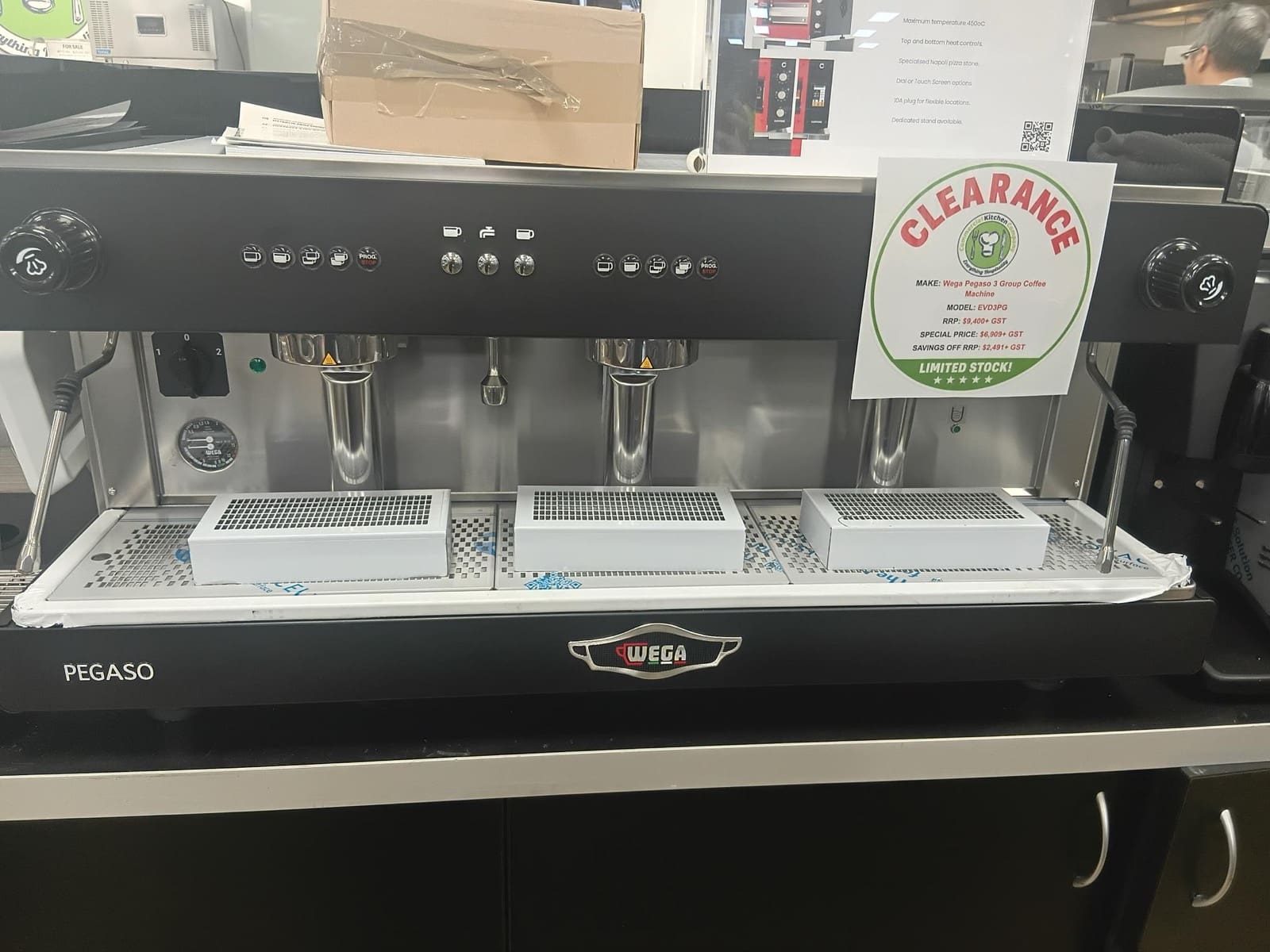
The steam boiler feeds your steam wands and hot water, so its capacity sets how much milk you can steam back to back before pressure drops. Across the range we stock, steam boilers run from 7 L on the compact two group Sanremo Zoe Compact, through 10 to 11 L on full-size two group machines, to 17 L on three group machines such as the Wega Pegaso EVD 3 group and Bezzera Moda DE 3 group.
The other choice is boiler type:
This is the one that catches people out. A full-size commercial espresso machine draws far more than a standard 10 A power point supplies:
| Machine | Power and supply (from the manufacturer’s specification) |
|---|---|
| Sanremo Zoe Compact 2 group | 2.7 kW, 15 A, single phase |
| Sanremo Zoe Competition 2 group | 3.15 kW on 15 A; a 380–415 V option is also listed |
| Wega Rover 2 group | 3,000 W, 20 A plug, single phase |
| Wega Pegaso EVD 2 group | 3.7 kW |
| Wega Pegaso EVD 3 group | 5,000 W heating element |
Before you buy, have your electrician confirm the circuit at the coffee station. In an older shopfront, choosing a machine that suits a 15 A circuit may avoid a costly switchboard upgrade.
Most café machines are plumbed: they need a mains water connection for automatic boiler refill, plus a drain. The Wega Pegaso EVD 2 group, for example, needs a mains water connection for its automatic refill. Plan water treatment for your site’s water hardness in line with the manufacturer’s installation requirements, because scale is hard on boilers and heating elements.
Mobile operators have options too. The Bezzera Otto Compact 2 group has a built-in pump and can run from a water tank, which suits coffee vans, food trucks, pop-ups and events. The Bezzera BZ10 semi-professional machine needs no connection to a water supply at all.
If most of your trade goes out in takeaway cups, cup clearance matters every single shot.
The features that matter most are the ones that keep shots consistent when different staff are on the machine:
| Venue | Machines to shortlist | Why |
|---|---|---|
| Small café, tight bench | Sanremo Zoe Compact 2 group | 528 mm wide, 15 A supply |
| Takeaway-heavy café | Sanremo Zoe Competition Tall, Wega Polaris EVD (raised groups) | 140 mm and 122 mm cup clearance |
| High-volume, two baristas | Wega Pegaso EVD 3 group, Bezzera Moda DE 3 group | Three groups, 17 L steam boilers |
| Specialty and single origin | Bezzera Victoria | Independent boilers, PID temperature control |
| Consistency across staff | Astoria AB200, Wega Polar, Wega Rover | Shot timers, programmable doses, auto cleaning |
| Coffee van or pop-up | Bezzera Otto Compact | Built-in pump, runs from a water tank |
| A statement machine | Bezzera Eagle (Gold Classic) | Belle Epoque styling in polished brass |
The Sanremo Zoe Compact 2 group is just 528 mm wide with a 7 L steam boiler, and runs on 2.7 kW from a 15 A single-phase supply. Electronic auto-level, activated pre-infusion and an automatic group cleaning cycle come standard. If you need more steam for heavier milk volumes, the Sanremo Zoe Competition 2 group steps up to a 10 L boiler and adds a shot timer and cool-touch wands. See the full Sanremo range.
The Zoe Competition Tall 2 group has 140 mm of cup clearance against 85 mm on the standard machine, with a 10 L steam boiler, shot timer, pre-infusion and AISI 316L cool-touch steam wands. Wega’s Polaris EVD 2 group is the alternative, available with raised 122 mm group heads.
When two baristas share the machine at the peak, you want three groups and a big steam boiler. The Wega Pegaso EVD 3 group pairs a 17 L boiler with a 5,000 W element and raised 122 mm groups. The Bezzera Moda DE 3 group also runs a 17 L boiler, in an AISI 304 stainless body with thermostatic group control. Busy sites that don’t need a third group should look at the Wega Pegaso EVD 2 group, with its 10.5 L boiler. Browse the Wega range.
The Bezzera Victoria is a multi-boiler machine with independent boilers, PID thermostats, colour touch displays and Bezzera’s pressure profiling. It is built for cafés that change brew temperature between blends and single origins. For PID temperature control on each group of a three group volumetric machine, compare the Bezzera Ellisse 3 group.
The Astoria AB200 and Wega Polar share a barista-focused feature set: shot timers, four programmable volumetric buttons per group, steam levers with a purge function, LED barista lights and an automatic self-cleaning function. The AB200 also comes in one, two (standard and compact) and three group sizes across the Astoria range. The Wega Rover 2 group adds cool-touch steam wands and an automated cleaning cycle, on a single-phase 20 A plug.
The Bezzera Otto Compact 2 group has a built-in pump and can be connected to a water tank, so it suits food trucks, coffee vans, pop-ups and trade shows. If you need a machine with no water connection at all, there is the Bezzera BZ10 semi-professional machine.
If the machine is part of the fit-out’s look, the Bezzera Eagle Gold Classic 2 group is a replica of a Belle Epoque espresso machine with a polished brass body, while still working as a volumetric two group machine. See the full Bezzera range.
A great machine can’t fix an inconsistent grind. Budget for the grinder at the same time as the machine, and if you run a decaf or a single origin alongside your house blend, plan bench space for a second one. Our commercial coffee grinders include the Mazzer range.
A commercial coffee machine is a significant purchase, and many venues spread the cost. We offer SilverChef finance on equipment purchases, and our guide to buying vs leasing commercial kitchen equipment sets out the trade-offs.
Coffee oils build up on the group heads, shower screens and baskets through the day, and left there they taint the next shot. A typical café routine:
Add the coffee machine to your equipment maintenance checklist so these jobs have an owner on every shift.
How many group heads does a café need?
Most cafés run a two group machine. Choose three groups if two baristas will work the machine at the same time during your peak, and one group for low-volume service such as a restaurant bar or breakfast station.
Can I plug a commercial coffee machine into a normal power point?
Usually not. Full-size commercial machines typically need a 15 A or 20 A circuit, and some run on three phase. Check the machine’s electrical specification and have your electrician confirm the circuit before you order.
What is the difference between a heat exchange and a multi-boiler machine?
A heat exchange machine uses one steam boiler and heats brew water as it passes through a heat exchanger. A multi-boiler machine gives the coffee its own temperature-controlled boilers, so brew temperature can be set independently of steam.
Do I need a tall-cup machine?
If a large share of your trade is takeaway, yes. Standard group heights suit ceramic cups; raised groups or an adjustable drip tray let takeaway cups sit under the spouts.
Browse our full range of commercial coffee machines, or talk to our team about your volumes, bench space and power supply. Visit us in Brisbane (1/1 Carol Avenue, Springwood) or on the Gold Coast (88 Upton Street, Bundall), call 1300 CKC 000, or get in touch.
Commercial Kitchen Company is the go-to source for high-quality hospitality supplies and equipment in Australia. As a proud, Australian-owned business, we cater to a diverse range of hospitality needs, including restaurants, cafes, catering services, and hotels in Brisbane and the Gold Coast. Our extensive selection in our showrooms highlights everything from advanced commercial kitchen equipment to essential front-of-house products, all aimed at enhancing the efficiency and appeal of your business.