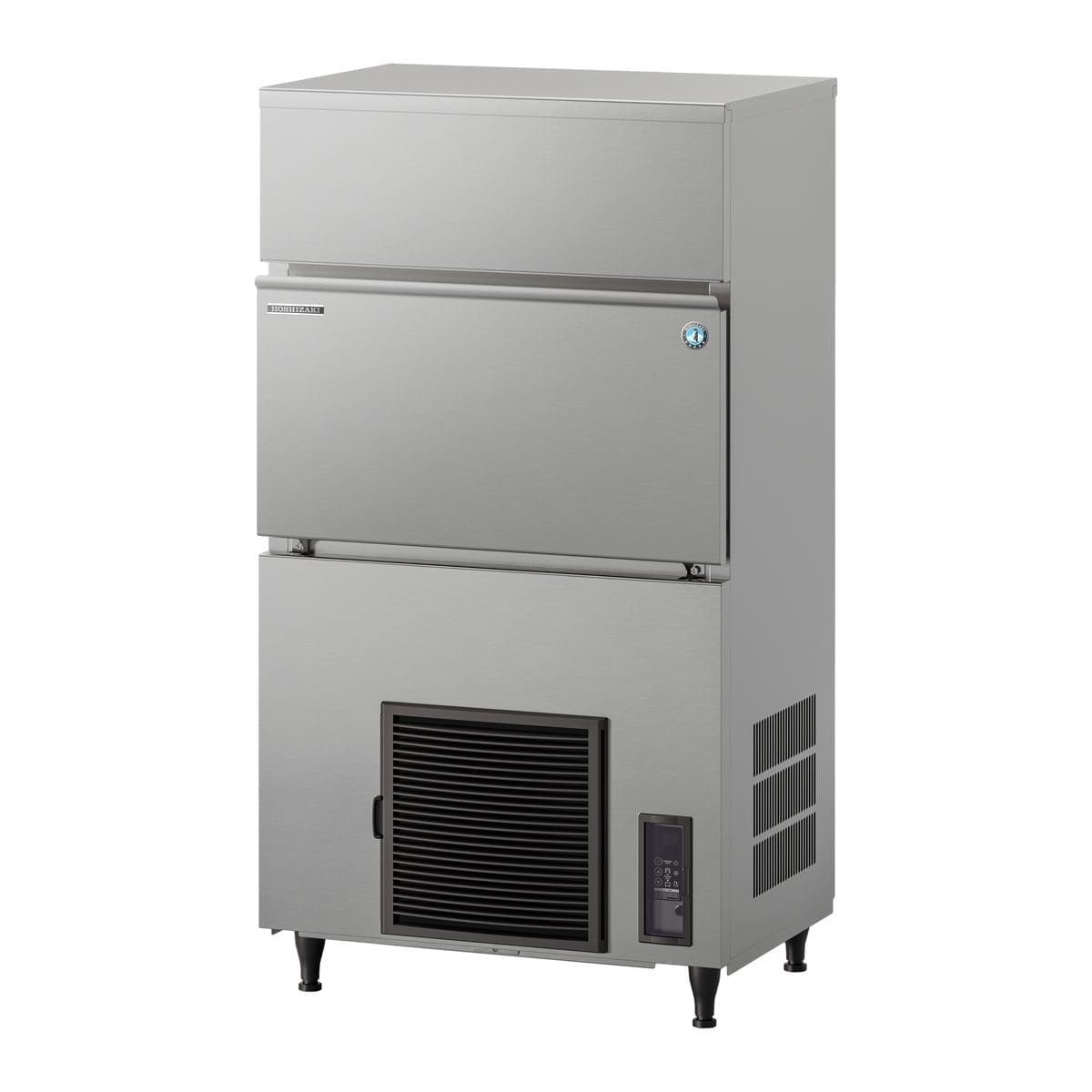
There is no single best commercial ice machine. There is the right machine for your venue: how much ice you use on your hottest, busiest day, what shape of ice your drinks or displays need, how warm the spot is where the machine will live, and whether there is a drain and a decent water supply nearby.
This guide works through the decisions that narrow the field, then shortlists machines by venue type from the commercial ice machines Commercial Kitchen Company stocks from Hoshizaki, SKOPE and Brema.
Every ice machine has two capacity figures:
A kilogram figure on its own can mean either, so check which one you are reading before you compare machines.
Production is slower than it sounds. Hoshizaki rates its IM-65PE-28-F at 39 kg a day at 32°C, only about 1.6 kg an hour, so through a busy service the bin does the work. Size both: production against your total use on your busiest day, storage against what you draw down in your busiest hour or two. Hoshizaki also quotes a lower bin control setting alongside maximum storage (about 18 kg against 26 kg on the IM-65PE-28-F): plan your rush around the lower figure.
| Ice type | What it suits | Machines in this guide |
|---|---|---|
| Cube and gourmet cube | Soft drinks, cocktails, water jugs and general bar use. Hoshizaki describes its cube as compact, dry and slow melting. | Hoshizaki IM range, SKOPE GALA (22 g gourmet-style cubes), Brema CB416A-HC-DP (13 g cubes) |
| XXL cube and ball | Whisky, premium spirits and signature cocktails, where slow dilution matters | Hoshizaki IM-65PE-LM, IM-65PE-Q |
| Crescent | Push-button dispensers. Hoshizaki says its crescent cubes don’t clump together in storage. | Hoshizaki KMD-201AB head with the DB-200H dispenser |
| Flake | Seafood and produce display, buffets and fast chilling | Hoshizaki FM-120KE-HC, FM-300AKE-HC-SB |
| Nugget | Soft, chewable ice for healthcare, aged care and high-volume drinks | Hoshizaki FM-120KE-HCN |
Flake packs around product without bruising it, which is why it goes under seafood and produce. FSANZ’s guide to Standard 3.2.2 makes the practical point for display: food on ice needs proper contact with it, so prawns should sit in direct contact with the ice, or the tub be deeply immersed in it, to stay chilled.
Ice machines make less ice as the room and the incoming water warm up. Hoshizaki publishes production at three sets of conditions:
| Hoshizaki model | 10°C air, 10°C water | 21°C air, 15°C water | 32°C air, 21°C water | Drop, 21°C to 32°C |
|---|---|---|---|---|
| IM-45CPE-28-F (cube) | 42 kg | 36 kg | 29 kg | about 19% |
| IM-65PE-28-F (cube) | 55 kg | 48 kg | 39 kg | about 19% |
| IM-130PE-28 (cube) | 109 kg | 102 kg | 91 kg | about 11% |
| IM-240PE-28 (cube) | 195 kg | 180 kg | 160 kg | about 11% |
| FM-120KE-HC (flake) | 125 kg | 105 kg | 82 kg | about 22% |
| FM-120KE-HCN (nugget) | 110 kg | 96 kg | 75 kg | about 22% |
Production per 24 hours from Hoshizaki’s specification sheets; the last column is our calculation.
Brema rates its CB416A-HC-DP at 42 kg a day at 21°C and 40 kg at 32°C. SKOPE quotes approximate daily figures for its GALA range, so ask our team for the rating conditions before comparing them directly with a Hoshizaki or Brema number.
If the machine will sit behind a bar, in a hot kitchen or in a store room without air conditioning through a Queensland January, size it on the 32°C figure, and check its operating range: SKOPE lists a 43°C maximum ambient for the GALA NG45 and NG60, and Brema rates the CB416A-HC-DP from 10°C to 43°C.
An air-cooled machine also puts its heat back into the room. Hoshizaki rates heat rejection at 32°C at 830 W for the IM-65PE-28-F and 2,580 W for the IM-240PE-28. In a small, closed room, a large machine warms the air it depends on.
Every Hoshizaki and Brema ice maker in this guide is air-cooled, according to its specification sheet. Air-cooled machines draw room air through a filter and across the condenser, so they need clearance around the cabinet and a clean filter. Hoshizaki’s manuals ask for the air filters to be cleaned at least twice a month. Clearances vary by model: Brema specifies 100 mm at the sides and back of the CB416A-HC-DP, Hoshizaki 30 cm at the rear, sides and top of the KMD-201AB head.
Water-cooled machines move that heat into water instead. Hoshizaki’s manual recommends connecting a water-cooled condenser to a closed-circuit recirculating system, such as a cooling tower or water chiller, and advises against running it on mains water, which wastes a large volume of drinking water. Without that kind of system on site, plan ventilation for an air-cooled machine.
Hoshizaki’s manual warns that scaling reduces performance and can cause malfunctions, and each manufacturer handles water quality differently:
Find out your site’s water hardness before you choose filtration, and budget for cartridge changes. Note too that cubers use more water than they turn into ice: Hoshizaki rates the IM-65PE-28-F at about 0.12 m³ (120 litres) a day at 21°C to make 48 kg, while its FM-120KE-HC flaker uses about as much water as it makes ice.
Most ice machines need a drain. Hoshizaki’s manual calls for an air gap of at least 5 cm between the drain hose and the floor waste, no direct connection to the sewer, and a steady fall on gravity drains. In some areas a plumbing permit and a licensed plumber are required.
Where there is no floor waste under the machine, a drain pump model pumps melt water to a drain elsewhere. Hoshizaki’s FlexiCube models carry an -F suffix, SKOPE’s GALA NG45 and NG60 A DP have an internal drain pump, and Brema says its CB416A-HC-DP can sit up to 4 metres from a drain.
On power, Hoshizaki’s specification sheets for its new-generation IM and FM machines list a single-phase 10 A plug and warn against running the machine from a multi-plug power board with other appliances. Brema’s CB416A-HC-DP also runs from a 240 V, 10 A plug.
For an under-counter spot, measure the opening, then add the clearance the manufacturer asks for:
| Machine | Width × depth × height | Daily production | Drain |
|---|---|---|---|
| SKOPE GALA NG45 A DP | 465 × 595 × 789 mm | about 47 kg | Internal pump |
| Brema CB416A-HC-DP | 497 × 592 × 687 mm (without feet) | 42 kg at 21°C | Integrated pump |
| SKOPE GALA NG60 A DP | 535 × 595 × 789 mm | about 55 kg | Internal pump |
| Hoshizaki IM-45CPE-28-F | 633 × 511 × 780 mm | 36 kg at 21°C | Integrated pump |
| Hoshizaki IM-65PE-28-F | 633 × 506 × 930 mm | 48 kg at 21°C | Integrated pump |
Ice goes straight into drinks, so the bin, the scoop and every surface the ice touches are food-contact surfaces. Standard 3.2.2 of the Food Standards Code requires the food-contact surfaces of equipment to be clean and sanitary whenever food that touches them is likely to be contaminated. Our guide to commercial kitchen requirements in Australia covers the wider rules.
Hoshizaki’s manuals for its cube, flake and nugget machines set this routine:
Hoshizaki also warns never to clean its machines with a water jet, or to wash the plastic parts in water above 40°C or in a dishwasher. Automatic cleaning cycles help but don’t replace the manual: for SKOPE and Brema machines, follow the intervals in their manuals. Add the ice machine to your equipment maintenance checklist so each job has an owner.
| Venue | Machines to shortlist | Why |
|---|---|---|
| Café or small bar, no floor waste | Hoshizaki IM-45CPE-28-F, SKOPE GALA NG45 A DP, Brema CB416A-HC-DP | Drain pumps, 465–633 mm wide |
| Restaurant or busier café | Hoshizaki IM-65PE-28-F, SKOPE GALA NG60 A DP | 48 kg at 21°C and about 55 kg a day, 25–26 kg bins |
| Busy bar or function venue | Hoshizaki IM-130PE-28, IM-240PE-28 | 102 kg and 180 kg a day at 21°C, self-contained |
| High volume, flexible layout | Hoshizaki IM-240APE-28 head on a B-301 SA bin | Production and storage chosen separately |
| Cocktail bar, premium spirits | Hoshizaki IM-65PE-LM, IM-65PE-Q | XXL cube and ball ice |
| Seafood, produce, buffets | Hoshizaki FM-120KE-HC, FM-300AKE-HC-SB | Flake ice, 105 kg and 250 kg a day at 21°C |
| Healthcare, aged care, drinks | Hoshizaki FM-120KE-HCN | Nugget ice, 96 kg a day at 21°C |
| Hotel guest floors | Hoshizaki DB-200H dispenser with a KMD-201AB head | Push-button dispensing, about 90 kg stored |
The Hoshizaki IM-45CPE-28-F makes 36 kg of cube ice a day at 21°C into a bin that holds up to 15 kg, with an integrated drain pump. If width is tight, the SKOPE GALA NG45 A DP is 465 mm wide and makes about 47 kg of gourmet-style cubes a day into a 20 kg bin; allow for SKOPE’s filter requirement. The Brema CB416A-HC-DP is 497 mm wide and makes 42 kg a day at 21°C into a 16 kg bin, on R290 natural refrigerant. See the Brema range.
The Hoshizaki IM-65PE-28-F makes 48 kg a day at 21°C, with up to 26 kg of storage and an integrated drain pump. The SKOPE GALA NG60 A DP makes about 55 kg a day into a 25 kg bin in a 535 mm wide cabinet, again with an internal drain pump.
The Hoshizaki IM-130PE-28 makes 102 kg a day at 21°C into a 50 kg bin, in a cabinet 704 mm wide and 1,280 mm tall; the IM-130PE-28-F adds a drain pump. For the busiest bars, the self-contained IM-240PE-28 makes 180 kg a day at 21°C with up to 110 kg of storage, in a cabinet 1,580 mm tall. Fitting out the whole bar? Plan the ice machine and the commercial glasswashers together, since both need water and drainage. Browse the Hoshizaki range.
A modular machine separates production from storage: the ice-making head sits on its own bin, or feeds a dispenser. The Hoshizaki IM-240APE-28 head makes the same 180 kg a day at 21°C as the IM-240PE-28, in a 560 × 700 × 880 mm head. Hoshizaki lists the B-301 SA storage bin, which holds up to 144 kg, among the bins for this head, with larger bins above it. The specification sheet sets out which bin and top kit suit each head, and our team can confirm the combination.
The Hoshizaki IM-65PE-LM makes an XXL cube, 38 kg a day at 21°C, and the IM-65PE-Q makes ball ice, 28 kg a day at 21°C into a 17 kg bin. Both share the IM-65PE-28-F’s 633 × 506 mm footprint but make less ice, so if the bar also needs ice for shaking and glasses, plan a standard cuber alongside.
The self-contained Hoshizaki FM-120KE-HC makes 105 kg of flake ice a day at 21°C, holds about 26 kg, and rinses out built-up minerals every six hours. For larger displays, the modular FM-300AKE-HC-SB makes 250 kg a day at 21°C and sits on a separate Hoshizaki bin.
The Hoshizaki FM-120KE-HCN makes 96 kg of nugget ice a day at 21°C and holds about 32 kg, in the same 640 × 600 × 800 mm cabinet as the FM-120KE-HC flaker.
Where guests or staff serve themselves, a push-button dispenser saves them reaching into a bin. The Hoshizaki DB-200H Hotel dispenser stores about 90 kg of crescent ice and dispenses 5 kg a minute. It is a dispenser only: the ice comes from a modular head sold separately, such as the KMD-201AB, which makes 175 kg a day at 21°C, fitted with the matching top kit. Hoshizaki specifies a 7–38°C ambient range for the dispenser, so keep it out of hot, unventilated corridors.
An ice machine is a long-term purchase, and the price is only part of the cost: budget for filtration, filter cartridges and the twice-yearly service visit Hoshizaki’s manuals call for. Many venues spread the cost. We offer SilverChef finance on equipment purchases, and our guide to buying vs leasing commercial kitchen equipment sets out the trade-offs.
Fitting out a new venue? Our commercial kitchen equipment list shows where the ice machine fits, and the wider commercial refrigeration range covers the fridges, freezers and blast chillers around it.
How big an ice machine do I need?
Work out the ice you use on your busiest day and choose a machine whose production at 32°C covers it. Then check the bin holds enough for your busiest hour or two, because a smaller machine makes only a kilogram or two an hour during the rush.
Do I need a floor drain for an ice machine?
Most machines need a drain. Gravity-drain models need a floor waste below them with an air gap and a steady fall. Drain pump models, such as Hoshizaki’s FlexiCube (-F) machines, SKOPE’s GALA NG45 and NG60 A DP and Brema’s CB416A-HC-DP, pump melt water to a drain elsewhere.
How often should a commercial ice machine be cleaned?
Follow your manufacturer’s manual. For its machines, Hoshizaki calls for the scoop and bin handle to be sanitised daily, the bin cleaned and sanitised weekly, the air filters cleaned at least twice a month, and the water system cleaned and sanitised by a trained service person at least twice a year.
Browse our full range of commercial ice machines, or talk to our team about your volumes, ice type, drainage and where the machine will go. Shortlisted one? Use the Add to Quote button on its product page, add a storage bin if you’ve chosen a modular head, and send the list from Quote in the menu for delivered pricing. Installation arrangement can be quoted alongside the equipment.
Visit our Brisbane showroom (1/1 Carol Avenue, Springwood) or our Gold Coast showroom (88 Upton Street, Bundall), call 1300 CKC 000, or get in touch.


Commercial Kitchen Company is the go-to source for high-quality hospitality supplies and equipment in Australia. As a proud, Australian-owned business, we cater to a diverse range of hospitality needs, including restaurants, cafes, catering services, and hotels in Brisbane and the Gold Coast. Our extensive selection in our showrooms highlights everything from advanced commercial kitchen equipment to essential front-of-house products, all aimed at enhancing the efficiency and appeal of your business.